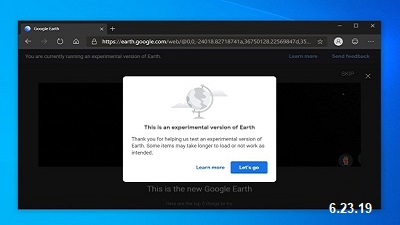
 Google Earth has been available on desktop for over two years now, and if you want to run the platform in a browser, you’ve to use Google’s Chrome. Other browsers including Chromium Edge and Opera aren’t supported because Google built Earth using Chrome-only technology. Google Earth is now available for all major web browsers, including [urlMicrosoft Edge and Firefox. Google created Earth web version using Portable Native Client (or PNaCl) and the original Edge or Chromium-based Edge does not ship with the Portable Native Client (PNaCl) component. Google has been working on WebAssembly-powered Google Earth and a version built using WebAssembly was demonstrated during the Chrome Dev Summit 2017. Google Earth has been finally rewritten in WebAssembly and the beta version now works on Microsoft Edge, Chromium web browsers and Firefox. The new version of Google Earth offers the same experience as the existing site. “Once the new version of Edge based on Chromium ships, apps in WebAssembly will work as well in Edge as they do in Chrome,” Google said in a blog post. While Google Earth works smoothly in new Edge, the platform is not fully supported in old Edge as the browser does not have Google Earth WebAssembly (WASM) Beta. Google Earth in old Edge renders the unsupported warning, but you can try to run it in multiple threaded or single threaded version, and it may work. We have more plus the link to try Google Earth posted on OUR FORUM.  Having your identity stolen can be a nightmare, and cleaning up the mess can take months. You can make life difficult for a would-be identity thief by locking down these five key aspects of your online life. What happened to my ZDNet colleague Matthew Miller this month is the stuff nightmares are made of. The title pretty much says it all: "SIM swap horror story: I've lost decades of data and Google won't lift a finger." In Matthew's case, hackers were able to convince T-Mobile to issue a replacement SIM that gave them access to his primary phone number. That, in turn, allowed them to reset passwords on his Gmail account, which pretty much gave them unfettered access to his entire identity. They then proceeded to shut down his Twitter account, wipe out everything associated with his Google account, and even access his online banking accounts. As I read Matthew's story, I had flashbacks to a similar incident that happened to Mat Honan back in 2012. Honan, who's now San Francisco Bureau Chief for Buzzfeed, documented his excruciating experience at the time in a memorable Wired article: "How Apple and Amazon Security Flaws Led to My Epic Hacking." The lesson from both of these horrifying experiences is that your primary phone number and your primary email address are far more valuable than you think. As our reliance upon online services grows, these two data points are extremely common means of authentication. If either one is compromised, an attacker can do bad things. And if those two factors are tied too closely together, it's game over for your online identity. You don't have to be the next victim. With a little effort (and, yes, a little expense), you can lock down the security of crucial online services. Follow these five guidelines and you can make life extremely difficult for a would-be identity thief. Fight hackers with 5 security safeguards we have posted on OUR FORUM.  Back in the day, Microsoft seemingly kept a long list of enemies otherwise known as competitors, as the company’s product portfolio grew in ambition. However, the days of vindictive and arguably petty Microsoft seem to be behind the company as it’s enemies list shrinks and its collaboration roster expands, yet, there are still a few areas in where the company keeps a healthy competitive nature and to that end, some software, services, and companies remain on a figurative and literal blacklist. According to a report from GeekWire, not only does Microsoft have a figurative blacklist, there is a literal blacklist of products that have been obtained and services from the following companies are frowned upon in internal use by the Redmond-based software company including obvious names such as Amazon Web Services and Kaspersky as well as a few head-scratchers in Grammarly and GitHub. Perhaps, the most noteworthy exclusions come from recent IPO darling Slack, to which Microsoft offers a competitor product in its Teams communication service. Unlike its more neutral stance on cross-platform usage and development, Microsoft seems to be taking an active roll in discouraging and even prohibiting the use of Slack by company employees. We have some of this prohibited software posted on OUR FORUM. |
Latest Articles
|